Start with the people who know your business. Turn their experience
into a reviewed picture of today’s work and a practical roadmap to
working with agents.
A 36-second method explainer. The service workflow is illustrative;
this is not a recording of the product interface.
Open the film full size ↗
Read the film description
Scope. Agree what you want to understand.
Listen. Let each role tell its part.
Map. Connect accounts into an as-is picture.
Validate. Make room for corrections.
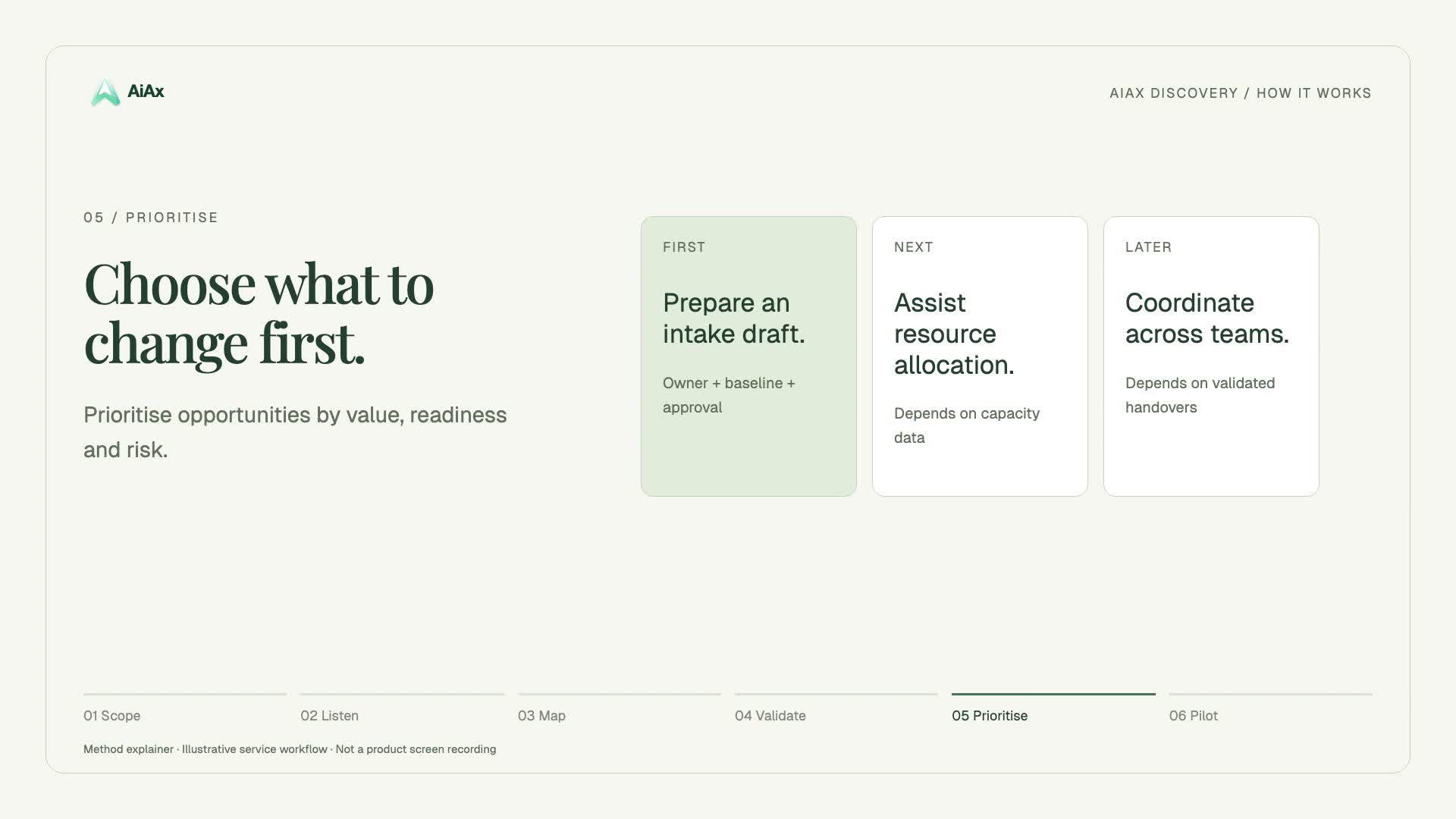
Prioritise. Build a roadmap to agent-native work.
Pilot. Move from discovery to a working workflow.
Animated voice bars represent an interview. The film has no spoken
audio. The map and roadmap use a fictional service-request workflow.
A shared effort
Agents help uncover the work. Your people confirm the picture.
Discovery combines agent-led interviews with analysis and review. It
is a structured engagement, not a promise that software can infer your
entire business from a single conversation.
Choose a business area, process owner and outcome. Identify the
leaders, specialists and people doing the work who can explain it.
Agree the source material and access needed.
You bring
A business question, an owner and relevant participants.
AiAx Interview uses role-specific questions to explore real tasks,
decisions, tools and exceptions. Leaders explain priorities.
Process owners explain dependencies. People doing the work explain
what happens in practice.
We explore
Triggers, handovers, manual work, systems and recurring friction.
You leave with
Interview transcripts and draft findings to review.
Combine the findings with the material in scope. Map the steps,
roles and systems involved. Keep gaps and disagreements visible
instead of treating every account as a confirmed fact.
We connect
Process steps, owners, systems, source context and open questions.
You leave with
A draft process picture and the points that need checking.
Review the draft with the people responsible. Confirm the sequence
and responsibilities, clarify contradictions and arrange follow-up
where evidence is missing. Reviewers decide what is ready to
publish.
Your role
Correct, confirm or reject findings.
You leave with
A reviewed picture and a clear record of unresolved questions.
Assess candidate workflows together. Balance expected value
against data readiness, access, dependencies and risk. Choose a
first pilot with a named owner and a measurable outcome.
We compare
Value, feasibility, readiness and the cost of getting it wrong.
You leave with
A prioritised roadmap with dependencies and a pilot brief.
Use the reviewed findings to define a role or team agent, its
context and its limits. Plan how people direct and review the work
in Workspace and the app. Pilot delivery is scoped separately.
We define
Agent mandate, permissions, human review and success measures.
You leave with
An agreed starting point for implementation and evaluation.
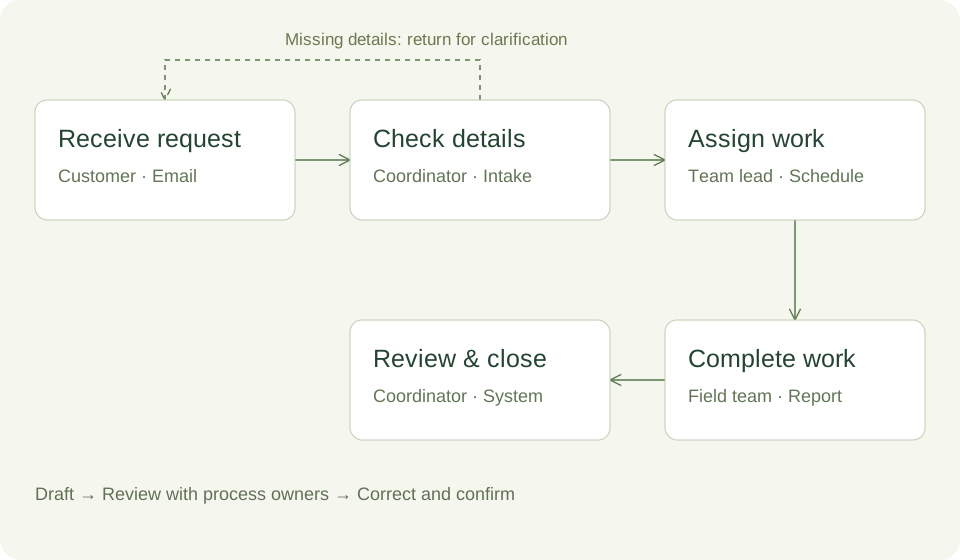
The as-is model
Follow the work. Find the handover.
A useful map connects an action to the person and system involved.
Exceptions and missing information belong in the picture too.
Here, a fictional service request passes from intake to
allocation, field work and review. It gives people something
concrete to correct together.
Illustrative process model. Open the sketch to view it at full
size.
What comes out of Discovery
A basis for action. Not another abstract AI strategy.
The agreed scope determines the deliverables. The aim is a decision
your team can act on.
A reviewed current-state picture
Roles, process steps, systems and the points where work gets
stuck.
An opportunity shortlist
Candidate workflows, expected value, dependencies and open
questions.
A roadmap and a first pilot
A sequence of work, a responsible owner and a result to measure.
Illustrative prioritisation, not a delivery commitment or an
automatically generated customer roadmap.
A concrete starting point
One workflow. A result you can evaluate.
For the service-request example, start by preparing an intake draft
for human review. Record how much correction it needs and whether it
reduces handling time. Expand only when the results and required
integrations justify it.
Discovery identifies the opportunity. The pilot tests whether it
holds up in real work.
Before you begin.
Who needs to take part?
A sponsor or process owner, people who perform the work and relevant
system or subject specialists. The mix depends on the area being
explored.
How long does Discovery take?
Scope, participant availability, the number of workflows and the
amount of follow-up determine the schedule. Agree the interview plan
and review milestones before starting.
Do we need to give access to all our systems?
No. Start with the material and access needed for the agreed scope.
Reviewing a document does not imply permission for an agent to
change a source system.
Does Discovery automatically build our agents?
No. Discovery defines the process, opportunities and proposed agent
responsibilities. Building integrations, deploying agents and
measuring the pilot are implementation work, scoped separately.
Start with a business question
Where does work slow down?
Bring one area you want to understand. We can start there.